Exercises to boost balance help assure independence


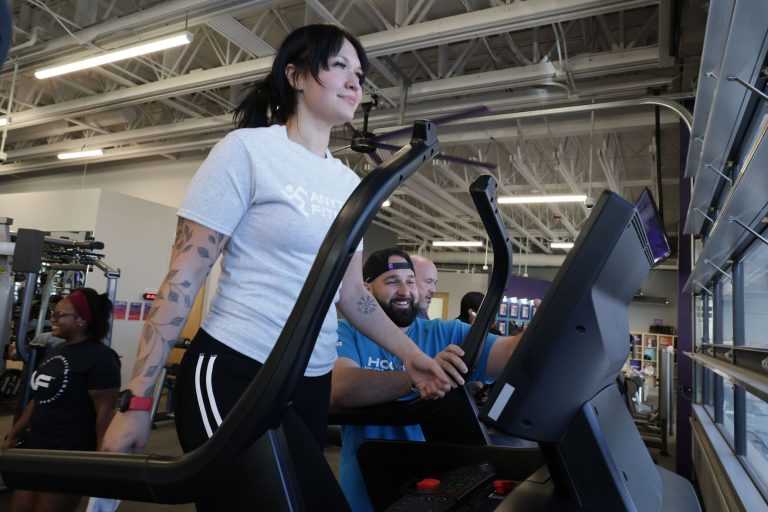
Andrew Magurany. wellness instructor and personal trainer, demonstrates exercises to help seniors improve balance.
For most people, fitness goals and regimens tend to evolve. For example, aggressive muscle-building and mile-stacking as a youngster may shift toward maintenance and management as the years pile up.
And for older adults, that shift should also include a new focus on improving their balance.
Why? Because the Centers for Disease Control and Prevention consistently reports falls as the leading cause of injury among adults 65 and older. And the further one advances beyond 65, the more likely a fall will result in the kind of serious damage, such as a brain injury or a hip fracture, that will lead to a broader loss of mobility and independence.
Balance training reduces fall risk and builds independence
“Improving balance helps reduce the risk of falls,” says Andrew Magurany, until recently wellness director at Crossroads YMCA Griffith and now fitness services supervisor at Community Hospital Fitness Pointe. “It also increases confidence in everyday movements like walking, climbing stairs or getting up from a chair. Over time, better balance supports independence and overall quality of life.”
Balance issues in older adults can stem from a combination of physical and neurological problems, including vision impairment, neurological changes that result in slower reaction time and general health problems and medication issues. But for most seniors, it is the loss of muscle mass and strength that typically accompanies aging that contributes most to balance problems. That’s why balance-focused exercises are so crucial.
“The older you are, the more important balance-specific exercises become,” says John Bobalik, a Silver Sneakers group fitness instructor for Highland Parks and Recreation and the former director of the Purdue Northwest Fitness Center. “Because while you cannot completely stop the impact that aging has on balance, you can significantly slow down the progression with the right exercises.”
It’s the natural evolution of exercise. The tactical goals may have changed as the years have gone by, but the overall strategy remains — to live a healthier and more fulfilling life.
“Maintaining or improving your balance as an older adult can keep you living independently and able to perform the activities of daily living while keeping you out of a rehabilitation facility or nursing home,” Bobalik says.
Balance-specific exercises make the difference
Fitness instructors Andrew Magurany and John Bobalik say older adults looking to build up their balance can start by giving these basic balance-specific exercises a try.
“These exercises directly affect your body’s ability to balance because they are all balance-related, specific exercises,” Bobalik says. “Other types of exercise don’t really help with balance. Walking, for example, improves cardiovascular endurance and is great for stress release, but it will not improve balance. Strength training on a machine, meanwhile, is great for improving strength, but since your body weight is supported by sitting on a machine, there’s no balance challenge. To improve your balance, the movement or exercise has to be balance-specific.”
Sit-to-stand
Sit in a chair with feet flat on the floor, then stand up without using your hands, if possible, and slowly sit back down. Repeat 8 to 12 times. This builds lower-body strength, which is essential for balance. Perform 2 to 3 sets 3 or 4 times per week.
Single-leg stand
Stand behind a sturdy chair and lightly hold it for support. Lift one foot a few inches off the ground and hold for 10 to 20 seconds, then switch sides. This strengthens the small stabilizing muscles in the legs and core. Aim for 2-3 rounds per leg, 3 to 5 days per week.
Four-stage balance routine
Step 1: Stand up, putting both feet together, extending your arms out to your side and holding your balance for 30 seconds.
Step 2: Place your feet in a staggered stance (left toe by right ankle or vice versa) and balance for 30-seconds.
Step 3: Place your feet in a tandem stance (one foot in front of the other which narrows your base of support) and hold for the same amount of time.
Step 4: Keep your feet in a tandem stance and close both eyes; when you take one sense away (such as vision), it makes keeping your balance more of a challenge.
Start safely and progress gradually
Magurany notes that safety comes first. Be sure to have a sturdy surface nearby for support and start with exercises that feel manageable.
Consistency is key, so short, regular sessions are more effective than occasional long workouts, he adds. Finally, it’s important to listen to your body and progress gradually to build confidence and avoid injury.
The older you are, the more important these types of balance exercises become, Bobalik adds. If you lose your balance and fall and end up in physical therapy, the therapist will make you do these exercises as part of your rehabilitation program, he adds. So get ahead of the program; do these as part of your regular exercise program to stay healthy and maintain your balance.
Related Articles